
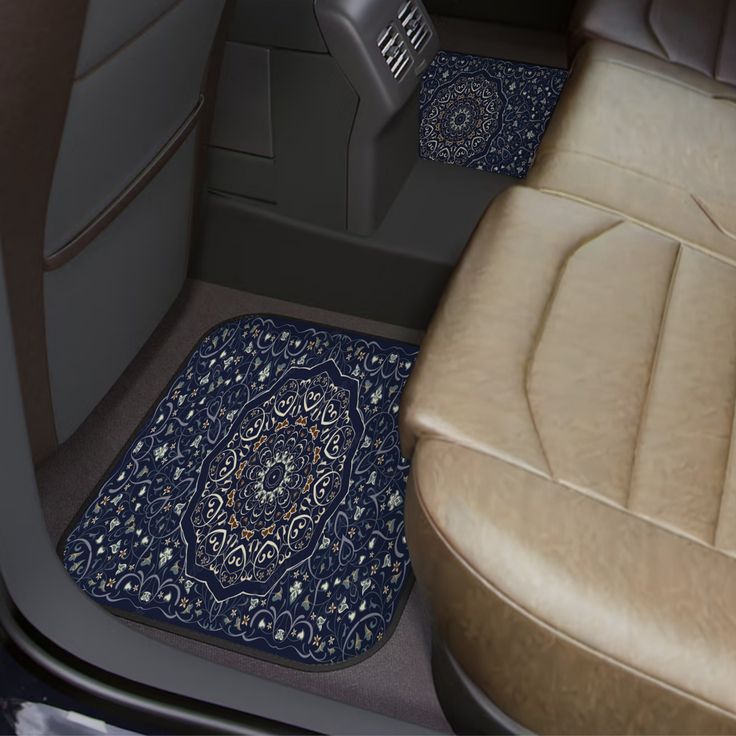
Moving Beyond the Idea of “Just Floor Protection”
In most vehicles, floor mats are treated as background components—functional layers that exist only to absorb dirt, moisture, and wear. They are rarely considered part of design identity. That assumption is exactly what Persian Car Mats challenge.
Instead of disappearing into the background, these mats introduce visual presence into a space that is usually dominated by neutral, industrial materials. They shift the role of a car floor from something purely utilitarian into something that participates in interior expression.
This is not a minor aesthetic upgrade. It is a redefinition of what a car interior can communicate.
The Design Logic Behind Persian Car Mats
Persian Car Mats are inspired by traditional Persian textile patterns, known for their dense geometric structure, floral symmetry, and symbolic repetition. These designs were originally developed for woven carpets meant for homes and ceremonial spaces.
When adapted into automotive mats, the patterns are not simply printed decorations. They represent a translation of cultural textile language into a mobile environment.
What makes this interesting from a design perspective is the contrast: cars are built around smooth surfaces, synthetic materials, and mechanical precision, while Persian patterns are organic in rhythm, detail-heavy, and historically handcrafted.
The combination creates visual tension—and that tension is what makes them distinctive.
Material Construction: Balancing Art and Durability
Despite their artistic appearance, Persian Car Mats are not fragile decorative items. They are engineered for constant friction, pressure, and environmental exposure.
Most versions include a multi-layer structure:
- A patterned top surface designed to replicate Persian textile aesthetics
- A reinforced middle layer that maintains shape under weight
- A non-slip base that keeps the mat stable during movement
The challenge in designing these mats lies in preserving visual detail while ensuring they can withstand daily driving conditions. Foot pressure, temperature changes, and dirt exposure all test the durability of the surface.
High-quality versions manage to retain pattern clarity even after extended use, which is essential for maintaining their visual identity.
Why They Stand Out in Modern Vehicle Interiors
Modern car interiors tend to follow a strict design language: minimal color variation, smooth surfaces, and uniform textures. While this creates a sense of cleanliness and order, it also leads to visual sameness across different vehicles.
Persian Car Mats disrupt that uniformity.
They introduce pattern density into a space that is usually visually quiet. This does not just change how the floor looks—it changes how the entire interior is perceived. Even when everything else remains unchanged, the mats alter the atmosphere.
This effect is subtle but noticeable. The car begins to feel less like a standardized product and more like a personalized environment.
Functional Advantages Beyond Appearance
While aesthetics are a major reason for their popularity, Persian Car Mats still serve practical purposes.
They are designed to handle:
- Daily dust accumulation
- Light spills and moisture
- Shoe friction and repeated pressure
- Seasonal temperature variations
One advantage of patterned surfaces is their ability to visually mask minor wear. Unlike plain mats where stains are immediately visible, Persian-style patterns naturally conceal small imperfections, helping the interior maintain a cleaner appearance over time.
This makes them both expressive and forgiving in real-world use.
Installation and Fit Precision
Unlike universal rubber mats that rely on weight and bulk, Persian Car Mats require more attention to fit. Because they often incorporate textile-like surfaces, proper alignment is important for both safety and appearance.
Most designs are shaped for specific vehicle models or include flexible edges that adapt to floor contours. A correct fit ensures:
- No interference with pedals
- No shifting during driving
- A visually aligned interior layout
Incorrect placement can reduce both safety and aesthetic value, which is why precision matters more than installation speed.
Cultural Design Migration Into Automotive Space
One of the more interesting aspects of Persian Car Mats is how they reflect cultural migration in design. Traditional textile patterns, once confined to domestic interiors, are now being applied to mobile environments.
This reflects a broader trend in design: functional objects are no longer expected to be visually neutral. Instead, they are becoming carriers of cultural identity.
In this case, Persian-inspired geometry moves from floor-based home décor into a constantly moving environment, bringing historical visual language into modern transportation spaces.
Maintenance and Long-Term Use
Maintaining Persian Car Mats requires a balance between care and practicality. Unlike rubber mats that can be aggressively washed, these mats benefit from more controlled cleaning methods.
Typical maintenance includes:
- Regular vacuuming to remove dust
- Light brushing to preserve surface texture
- Spot cleaning for spills
- Occasional deep cleaning depending on material type
Proper maintenance ensures that both the color depth and pattern sharpness remain intact over time.
When neglected, textile-based surfaces can lose vibrancy, which reduces their visual impact inside the car.
Conclusion: When Utility Becomes Expression
Persian Car Mats exist at the intersection of practicality and design storytelling. They still perform the essential function of protecting vehicle flooring, but they also introduce something that standard mats do not: visual identity.
Instead of being hidden beneath the driving experience, they become part of it. They change how the interior feels without changing how the vehicle functions.
In a market filled with uniform solutions, they stand out not because they are louder, but because they introduce a different design language into a space that rarely expects one.
0