
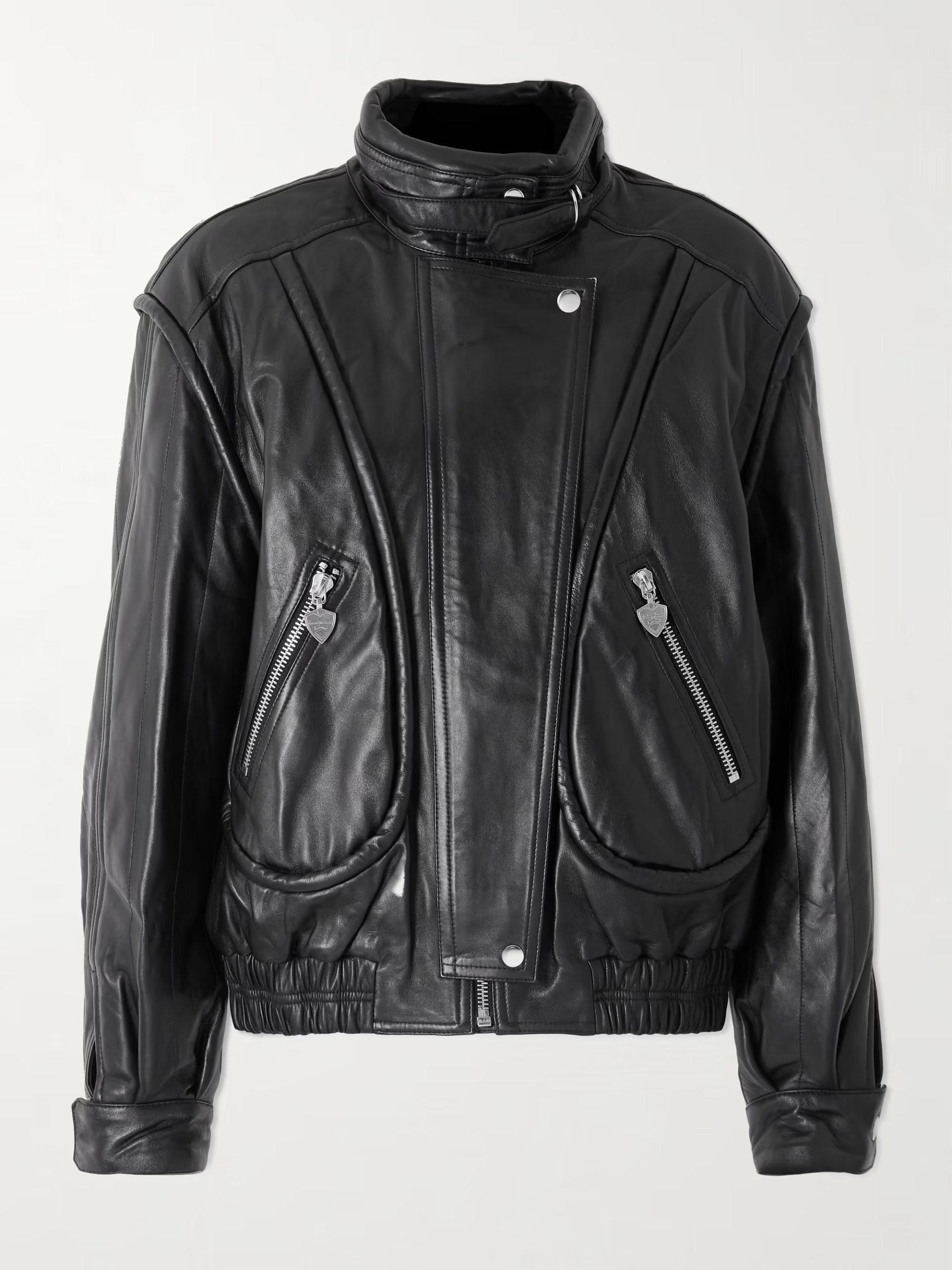
Not a Trend, But a Recurring Design Language
The Mens Leather Jacket is often treated as a fashion staple, but that description understates its role. It is not simply a recurring trend—it is a garment that continuously re-enters culture because it carries a specific visual and material language that other jackets rarely replicate.
While most clothing cycles in and out of relevance, the leather jacket behaves differently. It does not disappear and return in redesigned form. Instead, it stays present in the background of menswear, adapting subtly to each era without losing its core identity.
This persistence is what makes it structurally interesting from a design perspective.
Material Behavior: Why Leather Defines the Silhouette
Leather is not chosen for the Mens Leather Jacket purely for aesthetics. It has mechanical properties that directly influence how the garment behaves on the body.
Unlike woven fabrics, leather has density and directional resistance. It does not drape loosely; it holds shape. This creates a controlled silhouette that reacts minimally to wind and movement.
Over time, the material also responds to the wearer’s habits. Creasing forms in areas of motion, while smoother regions remain relatively unchanged. This uneven aging process is not a defect—it is part of how the material records use.
The jacket, in this sense, becomes a physical imprint of movement patterns.
Structure Over Ornament: A Design Built on Constraint
One of the defining characteristics of the Mens Leather Jacket is that its design is constrained rather than decorative.
Most elements exist for structural reasons:
- Seams are reinforced to handle tension points
- Zippers are placed to control closure symmetry under stress
- Collars are shaped to reduce airflow intrusion
- Panels are divided to manage flexibility without losing firmness
These constraints produce a distinct visual outcome: sharp edges, defined shoulders, and a compact torso profile.
Unlike softer jackets that prioritize flow, this design prioritizes containment. The body is framed rather than draped.
Cultural Repetition Without Redesign
The Mens Leather Jacket has been adopted repeatedly across different cultural contexts without undergoing fundamental redesign. This is unusual in fashion, where reinterpretation is often necessary for continued relevance.
Instead of changing the garment, culture changes its meaning.
In some contexts, it signals rebellion. In others, it represents minimal masculinity or functional style. In modern fashion environments, it is often used as a neutral anchor piece that stabilizes an outfit visually.
The jacket itself remains structurally identical, but its symbolic interpretation shifts depending on time, media, and subculture.
This adaptability without structural change is part of its longevity.
Why It Still Feels Visually Strong
Many garments lose impact when exposed to repeated styling trends. The Mens Leather Jacket does not follow this pattern because its visual strength is not dependent on decoration or seasonal design updates.
Its impact comes from geometry and material density. The combination of rigid structure and natural texture creates a contrast that remains visually readable regardless of surrounding fashion changes.
Even when paired with modern minimalist clothing, it does not feel outdated. Instead, it introduces weight and contrast into otherwise lightweight outfits.
This balancing effect is one of the reasons it continues to appear in both casual and semi-formal wardrobes.
The Role of Fit in Defining Identity
Fit plays a critical role in how the Mens Leather Jacket is perceived. Unlike relaxed garments, small changes in fit significantly alter its visual identity.
A tighter fit emphasizes structure and sharpness, creating a more defined silhouette. A slightly looser fit introduces a more relaxed interpretation without losing the jacket’s core rigidity.
Because the material does not flow easily, fit adjustments change perception rather than behavior. The jacket always maintains its structural presence regardless of size variation.
This makes tailoring decisions more impactful than in softer garments.
Aging as an Integral Design Outcome
One of the most distinctive aspects of the Mens Leather Jacket is how it evolves over time.
Instead of degrading uniformly, leather develops irregular patterns based on usage. Movement areas become more flexible, while less-used sections retain firmness. Surface tone may deepen or lighten depending on exposure.
This creates a layered visual history that cannot be manufactured at the point of sale. Each jacket becomes individually shaped by the wearer’s lifestyle.
This aging process is not treated as damage in this context—it is part of the garment’s identity formation.
Conclusion: A Garment That Resists Obsolescence
The Mens Leather Jacket remains relevant not because it is constantly redesigned, but because its foundational structure continues to serve both functional and aesthetic roles simultaneously.
It does not rely on seasonal reinvention or trend alignment. Instead, it maintains continuity while allowing interpretation to evolve around it.
In a fashion system that often prioritizes change, the leather jacket represents stability through structure. It is a garment that does not attempt to stay current—it remains present, regardless of what changes around it.
0