
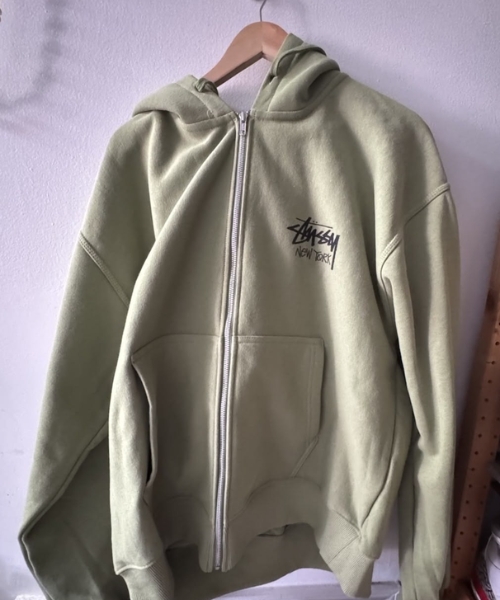
Most clothing brands spend a lot of time and money telling you who they are. Stussy never really had to. When Shawn Stussy started scribbling his signature onto surfboards in Laguna Beach back in the early ’80s, he wasn’t building a brand strategy — he was just signing his work. Those same looping letters eventually landed on T-shirts, and somehow that was enough. Word spread the old-fashioned way: someone wore it, someone else asked about it, and things moved from there.
What makes that origin story stick is that it was completely unpretentious. There was no pitch, no lookbook, no celebrity seeding campaign. It was just a dude’s handwriting on a cotton tee, and people liked it. That kind of beginning leaves a mark on a brand’s DNA that is hard to fake later on — and Stussy has never really had to.
Getting dressed on purpose
Here’s the thing about Stussy — it doesn’t scream for attention. It’s not covered in hardware or printed with giant text telling you how cool it is. If you’re wearing it, you chose it because you know what it is and why it matters to you. That’s actually a pretty rare thing in a market that runs on impulse and algorithm-driven recommendations.
People who dress intentionally — who actually think about what they put on in the morning — tend to build wardrobes differently. They’re not chasing drops for the sake of chasing drops. They’re not buying something because it’s everywhere right now. They buy things they genuinely want to wear, and they wear them until they fall apart or until they have a good reason to replace them. stussy fits that approach almost perfectly. It’s not demanding. It doesn’t need to be the center of attention. It just works, consistently, year after year.
More than just a logo tee
Most people’s first Stussy piece is probably that classic script logo tee, and honestly, it’s a great place to start. But if you stop there, you’re missing a lot of what the brand actually does. The catalog goes deep — heavyweight fleece, well-cut work pants, outerwear that holds up in actual cold weather, hats that don’t look ridiculous after the first wash, and accessories that fill in the gaps without being throwaway pieces.
The graphics across collections pull from a genuinely interesting mix of places. You’ll see surf references sitting next to typography that owes something to jazz poster design, or patterns that feel lifted from traditional textile traditions on the other side of the world. It never feels random — there’s a consistent sensibility running through it all — but it’s also not trying to be one thing. That range is part of what makes building a Stussy wardrobe feel like a real project rather than just buying versions of the same item over and over.
The collaborations tell you something
Stussy has worked with an impressively eclectic list of partners over the years — high-performance athletic brands, avant-garde fashion houses, independent Japanese labels, and artists who most people outside of niche circles have never heard of. The releases are almost always limited, and they move fast. If you own one, it means you were paying close enough attention to actually get one — which, in itself, is a statement about how you engage with clothing culture.
But more interesting than any individual release is the pattern across all of them. Stussy has collaborated in wildly different directions without ever looking confused or inconsistent. It has moved between high fashion and skate culture, between American and Japanese markets, between the underground and the mainstream, and come out the other side still looking like itself. That’s harder than it sounds. Most brands that try to do everything end up standing for nothing. Stussy figured out a long time ago that having a strong enough center means you can move to the edges without losing your footing.
The Tribe — and why community was always the point
By the late ’80s, Stussy had built something genuinely unusual: a loose international network of influential people in cities like New York, London, and Tokyo who wore and championed the brand entirely because they wanted to. These weren’t paid ambassadors with contracts and deliverables. They were DJs, artists, skaters, and people who just had good taste and the social gravity to make what they wore feel important to others around them.
The so-called International Stussy Tribe had no single look, no shared background, and no unified scene. What they had in common was a sensibility — an eye for things that felt real rather than manufactured. That spirit never fully went away, even as the brand grew. When you wear Stussy today, you’re not just wearing a piece of clothing. You’re, in a small way, connecting yourself to that lineage — to the idea that the best way to build something worth belonging to is to let real people find it on their own terms.
What the price point actually means
Stussy lives in an interesting middle ground in the market. It’s priced above disposable fast fashion, but it’s not asking you to remortgage anything to afford a hoodie. That positioning is easy to overlook, but it’s worth thinking about — because where a brand sits in the market tends to reflect who it’s actually talking to.
At the bottom end, you’re mostly paying for volume. At the very top, you’re often paying as much for rarity and status signaling as for anything else. Somewhere in the middle — which is where Stussy lives — you’re making a more considered trade. You’re paying a bit more because the thing is better made and because the brand has actually earned its reputation. Resale values on desirable pieces stay strong not because the market has been gamed, but because people who own Stussy genuinely don’t want to let it go. That says something real about the relationship between the brand and the people who wear it.
A wardrobe that grows with you
Some people treat their wardrobe like a subscription — new stuff comes in every season, old stuff gets cleared out, repeat forever. That’s fine, but it’s a different relationship with clothing than the one Stussy tends to encourage. Because the brand’s aesthetic changes slowly and deliberately, a piece from six or seven years ago doesn’t look like a mistake next to something released last month. Things accumulate without clashing. An older graphic tee doesn’t announce itself as vintage — it just exists as part of the story your wardrobe tells.
That’s actually a pretty meaningful thing if you think about it. Building a collection of clothing that holds together over years — that has an internal logic, that reflects who you were at different points — is a very different project from constantly refreshing what you own. It requires having taste that doesn’t flip completely with every new trend cycle. People who dress this way tend to value the relationship they have with their things, not just the things themselves.
What the logo says without saying anything
The Stussy script has been on clothing for over forty years. In that time it has never really been loud about itself. It doesn’t announce wealth. It doesn’t shout affiliation with a sport, a celebrity, or a particular status bracket. What it does is act as a kind of quiet signal — one that people who know, know, and people who don’t simply see as good-looking clothing with interesting graphics.
That dual function is rare. Most logos are either too obscure to mean anything to anyone, or so ubiquitous that wearing them feels like walking around with a billboard. Stussy has stayed in the space between those two extremes for longer than almost any comparable brand. It has never chased the mainstream hard enough to lose the people who found it early, and it has never been so underground that it failed to reach new audiences. Wearing it comfortably in that space is, honestly, a pretty good description of a certain kind of person — and probably a good description of you, if Stussy is hanging in your wardrobe right now.